

Introduction:
Students who perform well on addition often struggle when mathematics requires them to work in reverse. This is not about effort—it is about how subtraction is taught. When subtraction is taught as a mirror-image procedure rather than a relational operation, students lack the framework to reason flexibly about difference, comparison, and missing quantities. The tools that could build that foundation visual models, part-part-whole reasoning, varied problem structures—are frequently bypassed in favor of procedures that produce answers without understanding (Nunes & Bryant, 1996).
This DMT Insight draws on research from mathematics education and cognitive psychology to answer a practical question: What does subtraction require students to understand—and why do so many struggle to learn it?
Key Idea •Students struggle with subtraction not because it is harder than addition, but because they are not shown the underlying structure.
The Core Problem: Subtraction Without Relational Structure
Subtraction is often taught as a procedure, but it is fundamentally about relationships between quantities. At its core, subtraction asks: What is the total? What quantity do we know? What quantity is missing?
Students must understand that a total is composed of quantities, and that those quantities can be composed or decomposed while the total remains equal. When this structure is not developed, subtraction becomes a set of disconnected steps. Students may produce correct answers in familiar situations, but they struggle when the context changes because they are not reasoning about the relationship between quantities (Fuson, 1992; Nunes & Bryant, 1996).
Mathematics education researchers have observed that subtraction is not a single operation but a family of problem situations. Verschaffel, Greer, and De Corte (2007) identified at least three distinct semantic structures:
· Take-away: removing a quantity from a set (the most commonly taught form)
· Missing addend: determining what must be added to reach a total
· Comparison: finding the difference between two quantities.
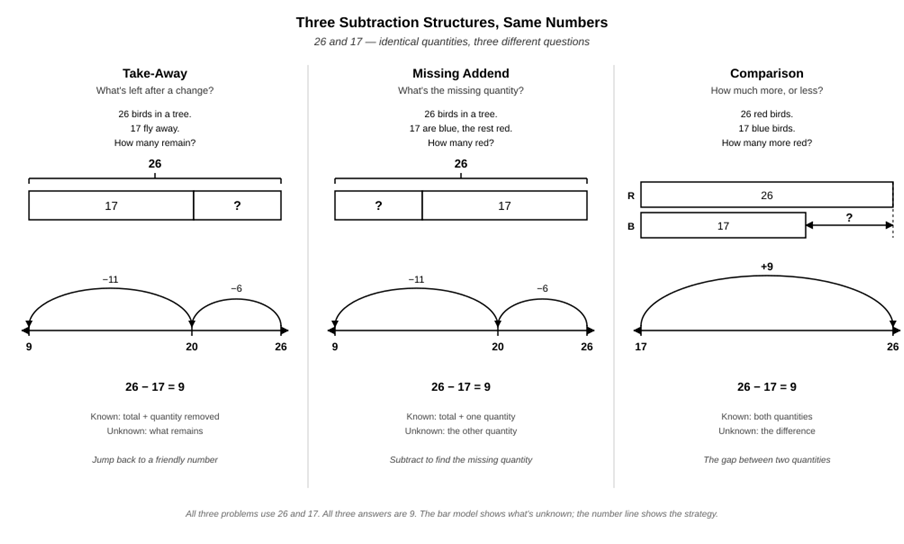
Figure 1. The same numbers, 26 and 17, generate three different questions, three different bar model structures, and three different number line strategies.
Students often succeed with take-away problems but struggle with comparison or missing-addend problems—even when the numbers are the same—because they are reasoning about different relationships. When instruction emphasizes procedures instead of relationships, students must rely on memory rather than understanding. They try to follow steps without a clear sense of what the quantities represent or how they relate to the total (Sweller, 1988; Hiebert & Carpenter, 1992).
Key Idea •Subtraction is about reasoning with quantities and totals—students must understand how quantities combine, separate, and relate within a total, not just how to follow steps.
Predictable Errors and Their Instructional Roots
The errors students make in subtraction are not random. They are predictable outcomes of instruction that emphasizes procedures over structure. The most widely documented error is the “smaller-from-larger” pattern (Brown &VanLehn, 1982), in which students subtract the smaller digit from the larger one regardless of place value (e.g., 274 − 138 = 164). These errors occur when students try to follow a procedure they do not fully understand.
From a cognitive perspective, subtraction places high demands on attention and memory. Students must track units, steps, and relationships at the same time. When these demands exceed what students can manage, they resort to shortcuts that seem logical but yield incorrect results. Gathercole and Alloway (2008) showed that children made significantly more errors on subtraction problems requiring regrouping. The procedure demands that students simultaneously hold partial results, track position in the algorithm, and retrieve subtraction facts—overloading a system that was never given a conceptual foundation to lean on.
Research and classroom evidence reveal a consistent pattern of errors when subtraction is taught procedurally (Carpenter, Fennema, & Franke, 1996; Baroody, 2003):
· Smaller-from-larger errors
· Treating subtraction as reversible
· Applying take-away reasoning to all situations
· Failure to transfer to fractions and decimals
Key Idea •Most subtraction errors are not careless mistakes—they are logical responses to instruction that does not make structure visible.
What Cognitive Science Suggests
Working memory plays a central role in subtraction. When students solve subtraction problems—especially with larger numbers—they must track quantities, monitor their steps, and maintain relationships simultaneously. Research shows that when these demands exceed working memory capacity, errors increase, even when students understand the numbers involved (Gathercole & Alloway, 2008; Geary, 2011). This helps explain a common classroom pattern: students may appear to understand subtraction in simple cases but struggle as soon as additional steps or place value are introduced. The difficulty is not just the mathematics—it is the cognitive load placed on the learner (Sweller, 1988).
Subtraction also depends on how students represent quantities. Students draw on language (number words), magnitude (size of quantities), and a mental number line (distance between quantities) when reasoning about subtraction (Dehaene, 2011; Siegler & Ramani, 2009). When these representations are weak or disconnected, students struggle to interpret what subtraction is asking. Finally, affect plays a role. When students experience repeated difficulty, anxiety can reduce attention and working memory, leading to more errors (Beilock& Maloney, 2015). Visual models, clear language, and low-stakes opportunities to explain thinking help strengthen these representations and reduce cognitive load.
Key Idea• Subtraction requires students to coordinate quantities, language, and magnitude under cognitive load—strong representations and supportive instruction make this coordination possible.
A Coherent Instructional Pathway
Research points to a consistent instructional sequence that supports understanding across grade levels:
Begin with meaning using concrete and visual models
Introduce all three problem structures
Develop the addition–subtraction inverse
Build from structure to symbolic notation
Delay formal procedures until understanding is established
This progression aligns with Bruner’s enactive–iconic–symbolic (EIS) framework, where students move from action to representation to abstraction (Bruner, 1966). Studies on representational sequences show that students who experience concepts through multiple representations develop a more flexible and durable understanding than those who begin with symbolic procedures alone (Witzel, 2005; Flores, 2010).
Number lines and bar models are especially powerful because they help students see subtraction as distance and relationship, not just removal. Research shows that linear representations support students’ understanding of magnitude and improve their ability to reason about numerical relationships (Siegler & Ramani, 2009).
Multi-digit subtraction should be built on place-value understanding, where students decompose and recompose units while maintaining equality. When procedures are introduced before this understanding is secure, students rely on steps rather than reasoning, which limits transfer to new contexts (Fuson, 1992; Hiebert & Carpenter, 1992).
Key Idea •Effective subtraction instruction moves from meaning to structure to procedure—not the other way around.
Conclusion
Subtraction is challenging, not because students are incapable, but because it requires them to coordinate quantities, units, and relationships while managing cognitive load. When instruction focuses primarily on procedures, students may produce correct answers in familiar situations but struggle to explain their thinking or transfer it to new contexts. In contrast, when subtraction is built on a foundation of meaning—grounded in quantities and totals, developed across multiple representations, and connected to place value and the addition–subtraction inverse—students develop a coherent understanding they can apply across topics. This progression, from enactive to iconic to symbolic, supports students in seeing subtraction as a relationship rather than a rule. When students can reason about how quantities combine, separate, and remain equal, subtraction becomes not just something they can do, but something they understand and can use flexibly across the mathematics they encounter.
Key Idea• Subtraction becomes accessible and transferable when students understand the relationships between
References
Baroody, A. J. (2003). The development of adaptive expertise and flexibility. In A. J. Baroody & A. Dowker (Eds.), The development of arithmetic concepts and skills (pp. 1–33). Lawrence Erlbaum.
Beilock, S. L., & Maloney, E. A. (2015). Math anxiety: A factor in math achievement not to be ignored. Policy Insights from the Behavioral and Brain Sciences, 2(1), 4–12.
Brown, J. S., &VanLehn, K. (1982). Towards a generative theory of “bugs.” In T. P. Carpenter, J. M. Moser, & T. A. Romberg (Eds.), Addition and subtraction: A cognitive perspective (pp. 117–135). Lawrence Erlbaum.
Bruner, J. S. (1966). Toward a theory of instruction. Harvard University Press.
Carpenter, T. P., Fennema, E., & Franke, M. L. (1996). Cognitively guided instruction: A knowledge base for reform in primary mathematics instruction. The Elementary School Journal, 97(1), 3–20.
Dehaene, S. (2011). The number sense: How the mind creates mathematics (Rev. ed.). Oxford University Press.
Flores, M. M. (2010). Using the concrete-representational-abstract sequence to teach subtraction with regrouping to students at risk for failure. Remedial and Special Education, 31(3), 195–207.
Fuson, K. C. (1992). Research on whole number addition and subtraction. In D. Grouws (Ed.), Handbook of research on mathematics teaching and learning (pp. 243–275). Macmillan.
Gathercole, S. E., & Alloway, T. P. (2008). Working memory and learning: A practical guide for teachers. SAGE.
Geary, D. C. (2011). Consequences, characteristics, and causes of mathematical learning disabilities and persistent low achievement in mathematics. Journal of Developmental & Behavioral Pediatrics, 32(3), 250–263.
Hiebert, J., & Carpenter, T. P. (1992). Learning and teaching with understanding. In D. Grouws (Ed.), Handbook of research on mathematics teaching and learning (pp. 65–97). Macmillan.
Nunes, T., & Bryant, P. (1996). Children doing mathematics. Blackwell.
Siegler, R. S., & Ramani, G. B. (2009). Playing linear number board games improves low-income preschoolers’ numerical understanding. Journal of Educational Psychology, 101(3), 545–560.
Sweller, J. (1988). Cognitive load during problem solving. Cognitive Science, 12(2), 257–285.
Verschaffel, L., Greer, B., & De Corte, E. (2007). Whole number concepts and operations. In F. Lester (Ed.), Second handbook of research on mathematics teaching and learning (pp. 557–628). Information Age Publishing.
Witzel, B. S. (2005). Using CRA to teach algebra to students with math difficulties in inclusive settings. Learning Disabilities: A Contemporary Journal, 3(2), 49–60.
Social Media
Why do students who can add still struggle when mathematics requires them to subtract?
Because following steps is not the same as understanding relationships.
Our latest DMT Insight shows:
• Three structures, not one. Subtraction is a family of relationships between quantities and totals — take-away, comparison, and missing-quantity — not a single procedure.
• Same numbers, different relationships. Students often master take-away but stall on comparison and missing-quantity problems with the same numbers, because the relationships are different.
• Errors are predictable, not careless. When procedures outpace understanding, working memory overloads — and the errors that follow are systematic, not random.
• One structure, many years. The same part-quantity-total reasoning that anchors whole-number subtraction in Grade 1 carries forward into fractions, decimals, and algebra.
This isn’t about teaching subtraction differently. It’s about giving students a way to see the relationships behind the operation — from early arithmetic through algebra.
Read the full research overview at mathsuccess.io · dmtinstitute.com
Where do your students get stuck — understanding the relationship, or following the steps? Share your thoughts at contact@dmtinstitute.com.