

Introduction: From Word Problems to Mathematical Structure
Students who can compute fluently often stall the moment a problem appears in words. They know how to add, subtract, multiply, or divide, but when those same operations are embedded in language, the task becomes much harder. The issue is rarely the arithmetic itself — it is that students lack a way to organize the quantities and relationships in front of them. In many classrooms, students are taught to rely on keywords rather than analyze how quantities are connected, leading to guesses rather than reasoning.
Bar models also called strip diagrams or tape diagrams address this gap by representing quantities as lengths. Length is spatial, visible, and comparable. Students can see how one quantity is part of another, how two quantities combine, or how one exceeds another. Instead of asking, “What word tells me to add or subtract?” students begin asking, “What is the total? What are the parts? What is known? What is missing?” That is a far more powerful mathematical habit of mind (Ng & Lee, 2009).
Key Idea •Most students who struggle with word problems aren’t failing at computation — they’re failing to see the structure of the situation.
Historical Foundations: The Singapore Model Method
Bar models became widely known through Singapore mathematics in the 1980s, when the Singapore Ministry of Education worked to strengthen problem solving in the national curriculum. Educators found that many students could carry out arithmetic procedures but still struggled with non-routine and contextual problems. The issue wasn’t a lack of practice; students needed a better bridge between the story context and the symbolic mathematics. The Model Method gave students a consistent way to represent quantities before formalizing their thinking with equations (Singapore Ministry of Education, 2012).
This work fits closely with Bruner’s theory of representation, which describes a progression from enactive experience to iconic representation and then to symbolic abstraction (Bruner, 1966). Bar models sit in the critical iconic stage. They are not concrete manipulatives, but they are also not yet abstract symbols. Instead, they function as a bridge: students can move from acting on quantities to drawing them and then to expressing them symbolically. This bridging role explains why bar models extend coherently across addition, subtraction, multiplication, division, fractions, ratios, and early algebra.
Bar models were never intended as a one-time strategy for a specific type of word problem. Their strength comes from coherence the same representational logic can be used across topics and grade levels. A student who uses bars to represent part–whole relationships in Grade 1 can later use the same structure to compare quantities, represent multiplicative relationships, and reason about unknowns in pre-algebra.
Key Idea •Bar models occupy Bruner’s iconic stage — a bridge between concrete experience and symbolic abstraction that extends coherently across topics from arithmetic through early algebra.
What Bar Models Reveal About Mathematics
Bar models are powerful because they reveal underlying structure that is often hidden in symbols alone. In join, separate, and part–whole situations, a single bar represents a total quantity that can be decomposed into parts. Students see that quantities are not isolated values but connected parts of a whole.
Consider 245 = 200 + 40 + 5. The bar below shows how a three-digit number is composed of its place-value parts. Each rectangle is sized in proportion to its value, so the visual itself reinforces what the digits mean: 200 is much larger than 40, which in turn is much larger than 5.
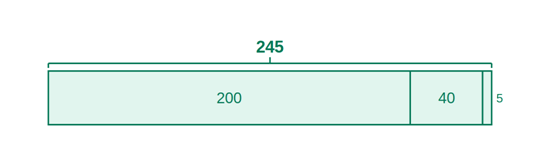
Figure 1. Place-value decomposition of 245. The bracket above the bar represents the whole; the parts are sized proportionally.
In a comparison situation, two bars represent different quantities, and the difference appears as extra length. This allows students to see the difference as a relationship rather than infer it from words. Below, a 10-cm stick is compared with an 8-cm worm. The arrow between the two bars marks the unknown — how much longer is the stick than the worm? Students can see the relationship before they compute it, then reason that the missing length must be 2 cm to complete the comparison.
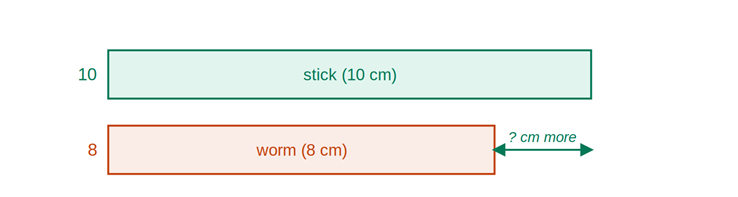
Figure 2. Comparison model. Two bars are drawn to scale; the arrow marks the unknown difference in length between them.
When units are equal, these same structures extend naturally into multiplication and division. A bar divided into equal units shows that the total is composed through iteration. Across all cases, students begin with structure rather than operations. They reason about how units fit together and come apart, rather than selecting procedures from a list (Carpenter, Fennema, Franke, Levi, & Empson, 1999).
Key Idea •Most arithmetic and early algebra problems come down to two structures part–whole and comparison and bar models make both visible..
Cognitive Foundations: Why Bar Models Work
Bar models are effective in part because they reduce the load on working memory. Word problems require students to process language, track quantities, and coordinate relationships at the same time. Drawing the relationship moves it out of the student’s head and onto the page, where it can be examined rather than held. This frees cognitive resources for reasoning rather than tracking (Sweller, 1988).
Bar models also support dual coding because students represent information both verbally and visually. These dual representations reinforce each other and improve comprehension and recall (Paivio, 1990). Over time, students begin to recognize recurring structures part–whole, comparison, equal groups and these structures become schemas that support transfer to new contexts (Hiebert &Grouws, 2007).
A final mechanism is spatial reasoning. Quantities become lengths, and relationships become spatially visible. Spatial representation helps students perceive abstract relationships more clearly and is strongly associated with long-term success in mathematics. One of the most important reasoning strategies supported by bar models is identifying the value of a single unit and then iterating or partitioning it a strategy that connects multiplication, division, fractions, and ratios into a single coherent way of thinking.
Key Idea •Bar models reduce working memory load, support dual coding, and build transferable schemas three mechanisms that make them effective even for students who struggle with traditional word-problem instruction.
From Bar Models to Algebraic Thinking
Bar models play a critical role in supporting the transition from arithmetic to algebra. Students first experience unknowns as quantities within a structure rather than as abstract symbols. As they grow more sophisticated, the same representation that helped them combine parts and compare quantities now supports reasoning with unknowns.
The bar below represents a problem like 4x + 5 = 53, where x is an unknown quantity that appears four times. The four equal bars labeled x show that the unknown is iterated four times; the smaller bar of 5 completes the whole, and the bracket above marks the total of 53. A student reasoning that the four x bars together must equal 48 and therefore each x must be 12 — is doing exactly the work that solving 4x + 5 = 53 makes formal. The structure of the equation is preserved in the diagram before it is written symbolically.
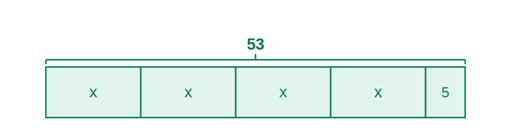
Figure 3. Algebraic reasoning. Four equal bars of x and a bar of 5 compose a whole of 53; reasoning about the structure leads directly to 4x + 5 = 53.
In this way, bar models support relational thinking, which is foundational to algebra (Carpenter et al., 1999). Students learn to see equations as representations of relationships rather than procedures to execute a shift that pays dividends well beyond elementary school.
Key Idea •Bar models preserve the structure of an equation before it is written symbolically, giving students a meaningful entry point into algebraic reasoning.
Developmental Progression: How Bar Models Grow with Students
The strength of bar models lies in how they evolve with the mathematics, not just repeat across grades. In the early grades, students use bar models to represent joining, separating, and part–whole situations, focusing on identifying the total (or whole) and its parts. Then this expands to comparison situations and equal groups, where students begin coordinating multiple quantities and recognizing relationships such as “more than,” “less than,” and “times as many.”
In upper grades, the representation becomes more precise and more powerful. Students use bar models to reason about fractions, scaling, and multiplicative relationships, working with partitioned units and iterating those units to build new quantities. By middle school, the same structure supports reasoning with unknowns, allowing students to represent relationships that lead directly to equations and algebraic thinking.
Rather than learning a new strategy each year, students refine a single representation that grows alongside the mathematics. This coherence is one of the most important features of the model and is a central reason it is associated with strong long-term outcomes in proportional and algebraic reasoning (Ng & Lee, 2009).
Key Idea •The same representation evolves with the mathematics from K through 6, supporting whole numbers, fractions, ratios, and early algebra students refine one tool, not many.
Using Bar Models Well and Where Instruction Goes Wrong
Bar models are most effective when used as a tool for making sense of relationships, not as a set of drawing steps to follow. When instruction focuses on replicating a diagram “draw this bar, label it here” students may produce correct-looking models without understanding the quantities they represent. The emphasis should be on using the diagram to answer questions such as: What does this part represent? How do these quantities relate? What is the unknown?
A critical instructional focus is helping students attend to units. Every bar represents a quantity, but more importantly, it represents a unit that can be composed, decomposed, partitioned, or iterated. As problems become more complex, students must track not just the numbers, but what those numbers represent. Without this attention to units, students may draw accurate diagrams that do not support correct reasoning.
Three failure modes show up repeatedly in classrooms. The first is treating bar models as a drawing procedure rather than a reasoning tool, which produces neat diagrams that don’t reflect the quantities in the problem. The second is skipping unit reasoning, so the model loses its mathematical meaning and becomes decorative rather than analytical. The third is reserving bar models only for “difficult problems” rather than using them consistently to build structure over time, which prevents students from developing the habit of reasoning about relationships.
Key Idea •The effectiveness of a bar model depends on attention to units and relationships, not on how accurately the diagram is drawn.
Conclusion: A Single Representation, Many Years of Reasoning
Bar models earn their place in classrooms because the same simple representation a length standing for a quantity carries students from kindergarten part–whole problems all the way to early algebra. Along the way it makes structure visible, takes load off working memory, and gives students a stable anchor for reasoning about units.
From both mathematics education and cognitive psychology perspectives, bar models work because they make structure perceptible, support schema development, and promote transfer. When taught with an emphasis on units, relationships, and reasoning rather than drawing rules, they become a high-leverage practice for building durable mathematical understanding from the early grades into algebra.
Key Idea• A single coherent representation used over time builds deeper understanding than many disconnected strategies layered year after year.
References
Bruner, J. S. (1966). Toward a theory of instruction. Harvard University Press.
Carpenter, T. P., Fennema, E., Franke, M. L., Levi, L., & Empson, S. B. (1999). Children’s mathematics: Cognitively guided instruction. Heinemann.
Common Core State Standards Initiative. (2010). Common Core State Standards for Mathematics. National Governors Association Center for Best Practices and Council of Chief State School Officers.
Hiebert, J., &Grouws, D. A. (2007). The effects of classroom mathematics teaching on students’ learning. In F. Lester (Ed.), Second handbook of research on mathematics teaching and learning (pp. 371–404). Information Age.
Ng, S. F., & Lee, K. (2009). The model method: Singapore children’s tool for representing and solving algebraic word problems. Journal for Research in Mathematics Education, 40(3), 282–313.
Paivio, A. (1990). Mental representations: A dual coding approach. Oxford University Press.
Singapore Ministry of Education. (2012). Mathematics syllabus: Primary. Curriculum Planning and Development Division.
Sweller, J. (1988). Cognitive load during problem solving: Effects on learning. Cognitive Science, 12(2), 257–285.
Social Media Post
Your students can compute. So why do word problems still stop them cold?
Because solving for an answer isn’t the same as understanding a relationship.
Our latest DMT Insight on Bar Models looks at why this single representation a length standingfor a quantity is one of the highest-leverage tools in elementary mathematics:
• Structure over keywords. Bar models help students see part–whole and comparison relationships instead of hunting for trigger words.
• Less load, more reasoning. Externalizing relationships onto paper frees working memory for thinking.
• One model, many years. The same diagram a first grader uses for part–whole becomes the foundation for fractions, ratios, and algebra.
• Units are everything. The model is only as strong as the student’s understanding of what each bar represents.
This isn’t about teaching a new strategy. It’s about giving students a consistent way to see structure from kindergarten through algebra.
Read the full research overview at www.dmtinstitute.com · MathSuccess.io
Where do your students struggle most with word problems seeing the structure, or choosing the operation? Share your thoughts at contact@dmtinstitute.com.